Title : The true (and surprising) impinges displacement healthy reasons.
link : The true (and surprising) impinges displacement healthy reasons.
The true (and surprising) impinges displacement healthy reasons.
raihan0326 in Health
For most people, healthy movement = exercise. As in models of cardio, crunches, and fitness. But moving the body is much more, such as improving thinking, stronger relationships, and expressing its purpose in life.
When most people hear healthy movement, exercise or think or look better fitness or weight loss.
Sometimes vanity.
Often, fitting in social norms.
"The Man" that tells what to do (or be).
moral rectitude packaged as 06 a.m. Detox class hot Pump Spin-late or a whole weekend of Instagram worthy of self-punishment.
But a healthy movement is actually more interesting, liberating, and, frankly, it is crucial that all of that.
In my years coaching health and fitness, here is the most important thing I discovered: The development of a body that moves well is the entrance to a place where you feel - finally - capable, secure and free.
We are all literally born to move.

is no secret :. Human life has become structured in a way that makes it very easy to prevent movement
They sit in the car on the way to work. At work we sit at our desks for much of the day. Then we got home and sit and relax.
That's not what our bodies are built to, so creaky knees, back rigid, and "I can not continue my child!" They have become the norm.
Of course, if you can not move well, it may be a sign that you are not as healthy as could be. But the quality and quantity of your daily movement - his strength and agility - actually are markers of something much more important
In my line of work, they see many people lose a lot of weight.. The results would be shocked -. And I'm not talking about how they look on the beach in a bathing suit (although there is always a big celebration for that)
Very often, things that people are more excited after going heavy and rigid to lean and agile is this feeling who are now living better. They realize they are:
- more energetic and young-feeling
- able to do things they have been putting off for years,
- entitled
- proud of their lifestyle, and
- free from many of the anxieties and limitations that held them for so long.
They are happier, but not just because they wanted to look better, and now they do. They are happier because their bodies now work as they are supposed to. Now they can do things they know they should be able to.
As human beings, we move our bodies to express our desires, needs, emotions, thoughts and ideas. Ultimately, how well we move - and how much we move. - Determines how well we relate to the world and establish our greatest purpose in life
If it moves so, also think, feel and live well.
There is evidence that a healthy movement helps us
- feel good, physically and emotionally
- productive function
- think , learn and remember
- interact with the world
- Communicate and express
- Connect and build relationships with others
do not need "training" To move.
shocking secret :. There is nothing magical about a circuit resistance class training camp in the gym, or the latest brand training method
Our ancestors did not have to "work" when walking, climbing, running, crawling, swimming, climbing, hauling, excavation, squatting, throwing and carry things to survive. Nor need an "exercise class" when they were to get places, she danced to share stories or ritualistic, or just ... played.
"is solving" is only an artificial way to get us to do what our bodies have, for most of human history, known and loved -. regular movements we have lost and forgot as we mature as a species
may not hunt for the dinner, and we can opt for the elevator most of the time.
We can move less. But the movement is still scheduled in the human brain as a critical aspect of how we relate to the world.
Therefore, to not movement is a loss much, much larger than the size of the pants.
What factors determine how you move your body?
While there are universal patterns of human movement, our specific movement habits are unique to us, and our bioengineering individually.
Basically, the human body is equivalent to a sophisticated battery of interconnected levers:
- Muscles are attached to bones by tendons.
- These tendons are connected to two (or more) through the bones of a joint.
- When a muscle contracts or shortens, pulling tendons bones.
- This contraction and traction makes the joint (curve) or double (extension) stretch.
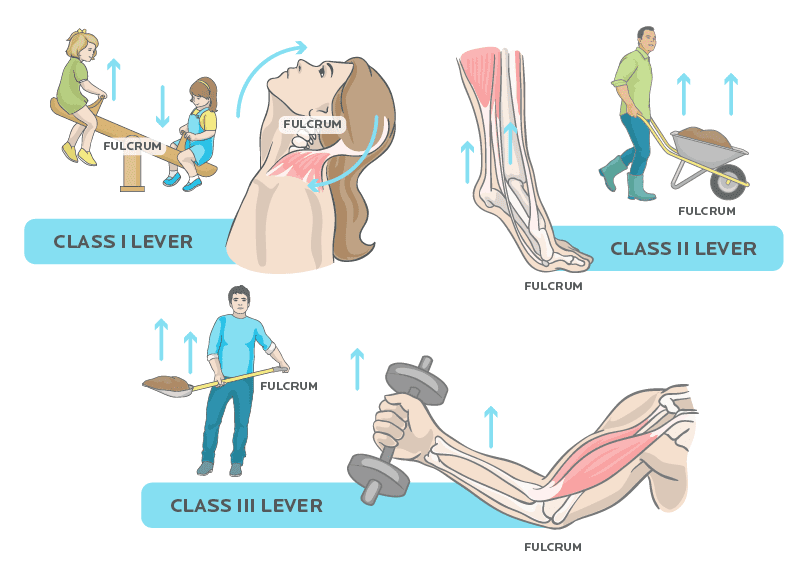
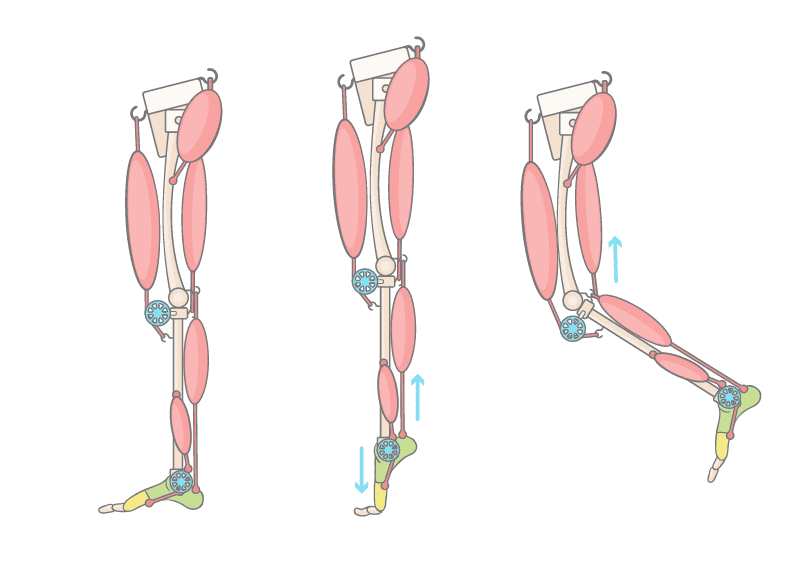
How it moves is determined by the size, shape and position of all parties, along with everything adds weight, as body fat.
If you are a tall person with the long bones may be harder for you to bench press, squat, deadlift, or the amount of weight to his shorter companion possible because their range of motion is much larger than his friend, so you have to move that weight a longer distance with much longer levers.
(This is why there are many lifters not super-high weights or weight lifters, and why large bench presses usually have a big chest and stubby arms T-Rex.)
However, you can probably beat his friend in the short swimming, climbing and running.
If you are bottom-heavy and / or shorter , which may not be able to run as fast as its highest friend. However, you may have the outstanding balance.
If you have gained weight in their midst (or are pregnant) , you may have back pain. That's because the extra belly weight pulls down on the lumbar spine (lower back).
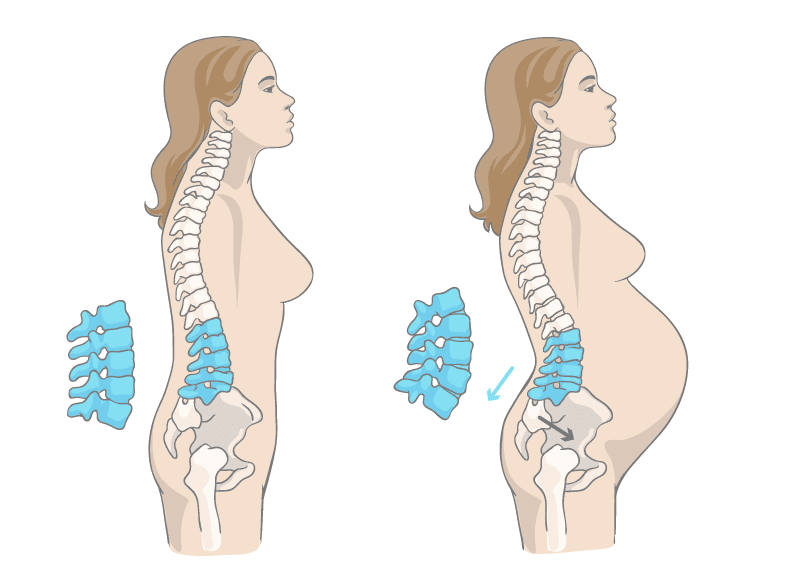
When the lumbar spine is pulled down and forward ( "lordosis"):
- The pelvis also inclined tips ( "pelvic tilt above "), the coccyx looks back and forward - the belly. Alias Donald Duck Butt
- The center back / top can round to compensate ( "kyphosis").
The pull down can also affect all joints below (the pelvis, hip, knee and ankle).
Conversely, it also works in the opposite direction, where, for example, ankle stiffness may affect movement in the lower back. wider
If you have shoulder ( "biacromial width"), then you have one arm longer lever, which means you can potentially throw, throw, swim or go better.
If you have longer legs , then you have longer stride, which means it can potentially run faster. This is especially true if you also have narrower hips , which create a more vertical angle femur ( "Q angle"), allowing you to spend less energy controlling pelvic rotation.
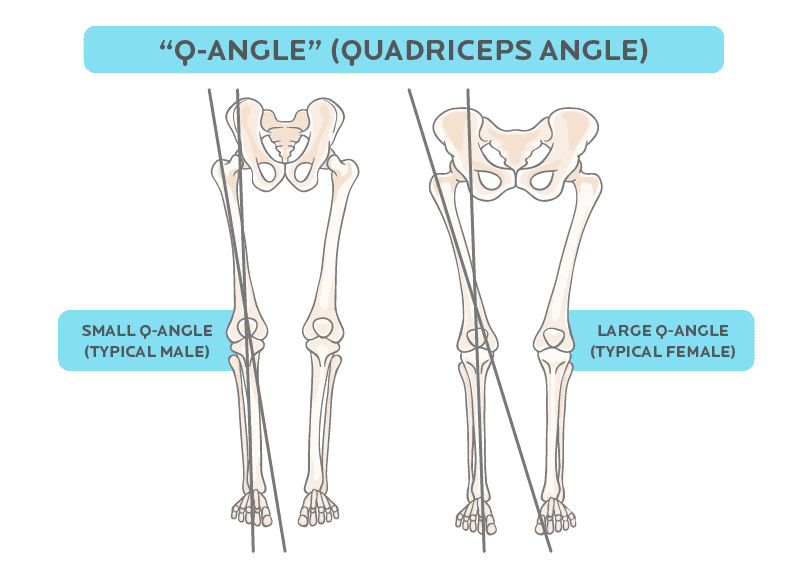
Some variations in the movement, which occur in nature and evolution. Other variations, to learn and practice.
If you are a woman who is top-heavy , which may have developed a feeling in his spine (upper and middle back), either from the physical weight of their breasts or social awkwardness of being the girl with tits in middle school.
Or, if you have very high at an early age , which may have developed a habitual hunch hide their size or communicate with hobbits like me.
However, structural engineering is still important. Especially if we understand how our structures and physical composition affect our movements.
For example:
body fat and weight changes how we move.
This is especially true if you do not have enough muscle to drive the motor.
With a healthy weight, your center of mass is right in front of the ankle joints when you stand upright.
However, the higher mass you have, especially if you are overweight on the front, plus the legs and feet have to work to avoid tipping forward.
This puts an additional torque (turning force) at the ankle joints.
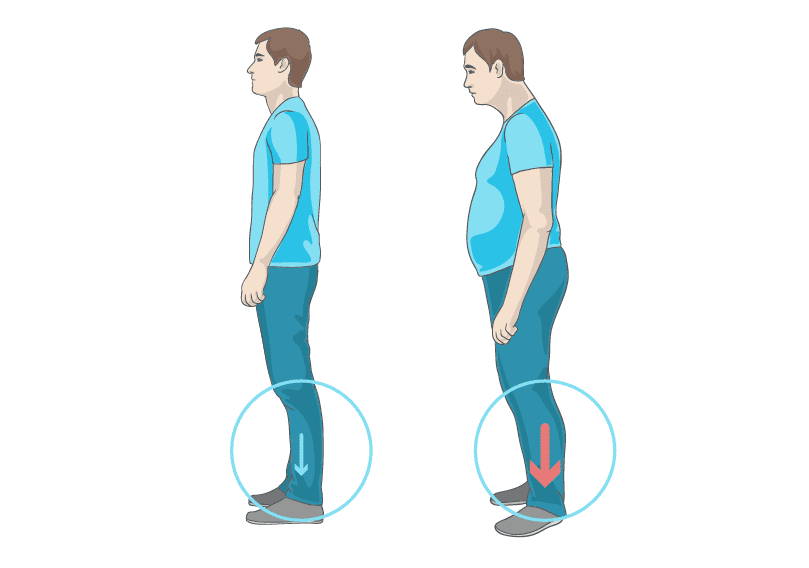
Once you start walking - that is, essentially, a fall forward controlled -. You have to work even harder to compensate
Any unstable surface or change (stairs, ice, soft carpet, a wet floor), requires lower joints to adjust their powerful and almost instantly -. Millisecond literally a millisecond
As a result, obese children and adults fall more often.
Human bodies are incredibly adaptable and intelligent, but however, the physics can be an unforgiving master.
The good news is that this is usually reversible.
No matter where you are starting out, the more you move, the better your body will work.
When we move
- our muscles contract;
- we load our connective tissues and bones;
- increase our breathing and circulation; and
- we release particular hormones and cellular signals.
All this (and a variety of other physiological processes) tell our bodies to use their raw materials and the food we eat in certain ways.
For example, the movement of our body says:
- to retrieve the stored energy (for example, fat or glucose) and use;
- to store any extra energy in the muscles, or use it to repair, rather than storing it as fat;
- to strengthen the tissues such as muscles, tendons, ligaments and bones; and
- to clear the accumulated waste products.
And improving body functions ensure that you will be able to move well and:
- climbing stairs or hills
- go over obstacles
- with purchases
- rise from sitting or rising from the floor
- grasp and hold objects like a hammer
- pull or drag things like a door heavy or dustbin
- an excitable dog walking
the more we can confidently and competently, fitters will. Even better, it means that we will do more. This leads to more fitness. And this virtuous cycle continues.
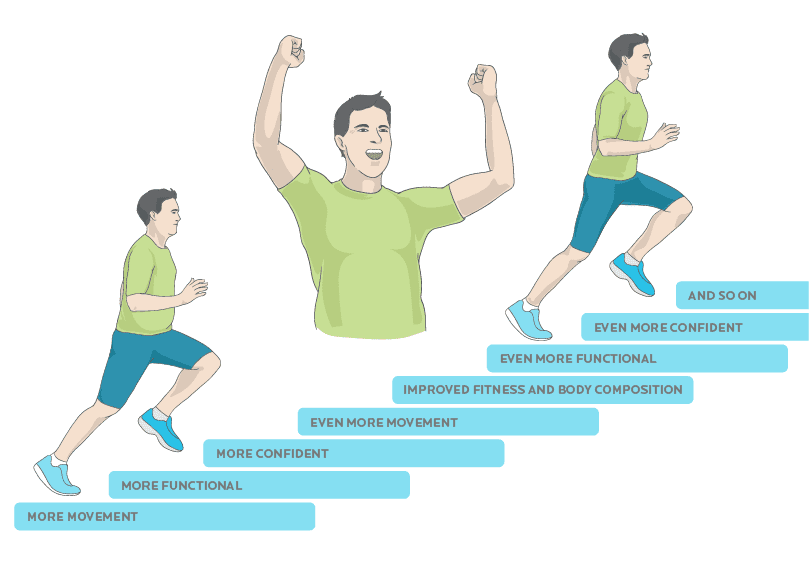
Movement does more than "get into shape".
Despite lenses and iPhones, humans are still animals. We are destined to move with the grace and agility of a tiger (or mono). And the movement offers a tremendous amount of benefits (sometimes surprising).

The movement is how humans (and other animals) interact with the world.
As babies, we immediately began to grasp things, put things in their mouths, trying to achieve things and clinging to our furry (now less) primates parents.
We are tactile beings, kinesthetic that must interact directly with the physical stimuli :. Touch, taste, handling, moving around objects in three-dimensional space
The movement helps connect and build relationships with others.
The movement is a sensor for the world around us.
In one study, when the facial muscles of people were paralyzed with Botox, could not read the emotions of others or describe their own. We need to imitate and reflect the body language and facial signals to each other to connect emotionally and mentally.
Since the position of chest inflation young men drunk outside a bar, Beyonce fierce dance moves, the mating rituals as inclined and eye contact with the laser close look at your mother gives when you know you're doing is not good:
Movement gives us a rich language, full of expressive nuances that goes far beyond words, help us build more satisfying relationships and durable, with fewer misunderstandings, disconnections, or outtakes communication.
Movement helps us to think, learn and remember.
Conceivably "thought" lives only in his head.
But in fact, research shows that we do what is called "embodied cognition." - In which body movements influence brain functions such as information processing and decision making, and vice versa
So "think" lives in our entire bodies.
But even if the thought is limited to our brain, there is no evidence that the movement and thought are intertwined.
turns out that the cerebellum - a structure at the base of the brain above can be used only for balance, posture, coordination and motor skills -. It also plays a role in thought and emotion
Moreover, the movement supports health and brain function in many ways, helping new neurons to grow and prosper (ie, neurogenesis).
Every day, our brain produce thousands of new neurons, especially in our region of the hippocampus, an area involved in learning and memory. Movement - if learning new skills or simply physical exercise improves circulation -. Give the new cells of a purpose for which they stay instead of dying
Therefore, movement:
- helps maintain existing brain structures
- helps slow the mental decline associated with age
- helps us to recover if our brain is injured or inflamed,
- reduces oxidative stress and
- increases levels of a substance known as brain-derived neurotrophic factor , or BDNF, which is involved in learning and memory.
move well, move often, be smarter.
movement affects how we feel physically and emotionally.
People of all shapes and sizes say they have a better quality of life with less physical limitations, when they are physically active.
If you exercise regularly, you probably know that kickass workouts can leave you feeling like a million dollars. (. Personally think mine as a medicine to control the dog)
The research comparing exercise alone with diet alone found:
People who change their bodies with exercise (instead of dieting) feel better - about their bodies, their abilities, their health and quality of life in general - although its weight in last doesn instance 't change .
(... Now imagine if you combine the magic of exercise with brain-boosting nutrition and development of the musculature!)
Find out what "healthy movement" seems to you.
Not everyone has to be (or can be) a ballet dancer or Olympic gymnast. As a 5-foot, 40-something woman who can not work well or catch a ball, I'm pretty sure the NBA and the NFL not called me.
But I also not saying, "Well, I guess I should not go upstairs because of my angle Q" is the way to go.
I'm saying :. Today, pay special attention to how it moves
Be curious.
As you go through the mundane activities of your day, notice how your unique body shapes their movements.
How you move ... and how you could potentially move?
In our training programs, we work with a lot of clients who have physical, such as limitations:
- pain or chronic movement restrictions - say, an injury or inflammation .
- too much body fat and / or not enough lean mass.
- too many or too few calories / nutrients feel energetic.
- age-related loss of mobility.
- a physical disability.
- neurological problems.
There may be some body configuration that makes it easier or harder for you to do certain things.
all have structural or physical limitations. We all have advantages. It all depends on the context.
Regardless of what might be their only physical composition, there are activities that can work for you, and help you make the movement of a large part of their daily lives.
Ask yourself:
How I can move better - which means to MI one body? And what could be my life as if I did?
And find someone who can help you if you think it is what you need.
What to do next
1. Pay attention to how it feels to move.
"sense" your body:
- When walking or running: What is your step? Do your legs swing freely? Do your hips feel tight or loose? What are you doing arms? Where are you looking?
- When it stands: How to change your weight smoothly while standing? What does it feel in your feet or legs?
- When you sit: Where is your head? You can feel the pressure of the seat on its back or bottom?
- When working: Can you feel the muscles working? What happens if you try viceversa make a quick move (as a jump or kick) slowly, and?
2. Consider whether you are moving as well as he could.
Do you feel confident and capable? Ninja-ready for anything?
Do you have some physical limitations? Do you have ways to adapt or route around them?
When was the last time you tried to learn new movement skills?
What movements Would you like to try ... in a perfect world?
3. Think of other ways to move.
If you are working out a certain way because you think you "should", but is not adjusted to your body well, consider other options.
Or, if your current training is going very well, but you are curious about other possibilities, consider expanding their repertoire of movement anyway.
Everything from archery to Zumba is out there, waiting to come and try it.
Remember: You do not have to "work" or "exercise" to move. And it is not necessary to renew their physical activity throughout the night, either.
Take your time. Do whatever you want. Choose a small new way you can move today -. And I do
4. Help the body to do its job with good nutrition.
quality movement requires quality nutrition.
And like their movements, their nutritional needs are unique to you.
Here's how to start figuring out what "optimal nutrition" for you:
If you feel you need help on these fronts, it succeeds.
A good fitness and nutrition trainer can:
- will help you find activities that suit your body.
- review their nutrition and offer advice on how to improve your diet (even if your life is hectic).
- help identify possible food sensitivities that could cause or worsen inflammation and therefore restrict their movements.
We have helped nearly 50,000 people eat, move and live better. We'd love to help, too.
If you're here, chances are you already know a lot about health and fitness. Do you want a deeper understanding, some definitive answers, and strategies to achieve that nutrition and movement work for you.
customers Precision Nutrition Training come to us looking for smart solutions and support with changes in lifestyle that have been trying to do for a long time. Our coaches help them find ways to get fit and healthy in the context of the real, messy human life - and how Stay that way :. Capable, safe and free
we accept new clients every 6 months, and stains often sell out within hours. But if you put your name on the list of pre-sale now, we'll let you register 24 hours before everyone else and give you a big discount on the program.
References
Click here to access the information sources referred to in this article.
Ballard-Barbash, Rachel, et al. Physics, biomarkers, and disease of cancer survivors activity: a systematic review. Journal of the National Cancer Institute 104.11 (2012) :. 815-840
Bize R, Johnson JA, Plotnikoff RC. level of physical health and quality of life of the adult population in general activity: a systematic review. Previous Med 45 (2007) :. JJ 401-415
Cao. Obesity effects on bone metabolism. J Surg Orthop Res. 2011 Jun 15; 6: 30. doi: 10.1186 / 1749-799X-6-30
Cash SW, Duncan GE, Beresford SAA, McTiernan A, Patrick DL.. Increases in physical activity can affect the quality of life differently in men and women: the PACE project. Quality of life research: an international journal of the quality of life of the aspects of treatment, care and rehabilitation. 2013; 22 (9): 10.1007 / s11136-013-0389-6. doi:. 10.1007 / s11136-013-0389-6
Chinapaw MJ, adequate KI, Brug J, van Mechelen W, Singh AS. Relationship between physical inactivity of youth and biomedical health indicators: a systematic review of prospective studies. Obes Rev. 2011 Jul; 12 (7): e621-32. doi: 10.1111 / j.1467-789X.2011.00865.x. Epub 2011 Mar 28.
Clark, Andy. Navigating uncertainty: Prediction, Action, and the body present. New York and London: Oxford University Press, 2015.
Clark, Andy. Supersizing the Mind: Embodiment, Action, and Cognitive Extension. New York and London: Oxford University Press, 2010.
Compston J. Obesity and bone. . Curr Osteoporos Rep 2013 Mar; 11 (1): 30-5. doi: 10.1007 / s11914-012-0127-y
Corbeil, Philippe, et al.. Increased risk of falling associated with obesity: Mathematical modeling of postural control. IEEE Transactions on Neural Systems and Rehabilitation Engineering 9 No. 2 (June 2001): 126-136.
Duncan, Michael J. Stanley and Michelle. Functional movement is negatively associated with weight status and positively associated with physical activity in children of British primary. Journal of Obesity 2012, Item 697563. doi: 10.1155 / 2012/697563
Egan, Brendan, and Juleen R. Zierath. exercise metabolism and molecular regulation of skeletal muscle adaptation. cellular metabolism 17.2 (2013): 162-184
Gómez-Pinilla, Fernando.. collaborative effects of diet and exercise on the improvement of cognition. Health Nutr. 2011; 20 (3-4) :. 165-169
Gonnelli S, C Caffarelli, R. Nuti Obesity and risk of fracture. Clinical Cases in Mineral and Bone Metabolism. . 2014; 11 (1): 9-14
Herman KM, Hopman WM, Vandenkerkhof EG, MW Rosenberg. Physical activity, body mass index and health of the quality of life in Canadian adults. Med Sci Sports Exerc. 2012 Apr; 44 (4): 625-36. doi:. 10.1249 / MSS.0b013e31823a90ae
Kantomaa, Marko T., et al. Physical activity and obesity mediate the association between motor function of children and academic performance of adolescents. Proceedings of the National Academy of Sciences 110.5 (2013): 1917-1922.
Kawashima S, Ueki Y, Kato T, Matsukawa N, Mima T, et al. (2012) Changes in striatal dopamine release associated with motor-skill Acquisition.PLoS human ONE 7 (2): e31728. doi: 10.1371 / journal.pone.0031728
Kruger, J, H R Bowles, D Jones A, B and H E W Ainsworth Kohl III. health quality of life, body mass index and physical activity among US adults (greater than or equal to 18 years): National Physical Activity Survey and weight loss, 2002. International Journal of Obesity ( 2007) 31, 321-327. doi:. 10.1038 / sj.ijo.0803386
Kusy, Krzysztof Jacek Zielinski and. Sprinters front runners: how healthy aging. Exerc. Sci sport. Rev., vol. 43, No. 1, pp. 57Y64, 2015.
O'Keefe, James H., Robert Vogel, Carl J. Loren Cordain and Laviec. Exercise as a hunter-gatherer: A recipe for Organic fitness. Advances in Cardiovascular Disease 53 (2011) 471-479.
Owusu, William, et al. Anthropometry body and the risk of hip fractures and wrist fractures in men: results of a prospective study. Obesity Research 6 No 1 (January 1998). doi: 10.1002 / j.1550-8528.1998.tb00309.x
Pucci GC, Rech CR, Fermino RC, RS Reis. Association between physical activity and quality of life in adults. Rev Saude Publica. 2012 Feb; 46 (1): 166-79
Rhodes, Jill.. How strong were the Neanderthals? Leverage and muscles in the shoulder and elbow in the musterienses gatherer. Periodicum Biologorum 108 No. 4 (2006): 457-470
Sampaio-Baptista, Cassandra, et al..
The post The true (and surprising) impinges displacement healthy reasons. appeared first on http://lawyers-blog.net/index.php/2016/05/08/the-real-and-surprising-reasons-healthy-movement-matters/
Thanks for Reading The true (and surprising) impinges displacement healthy reasons.
You are now reading the article The true (and surprising) impinges displacement healthy reasons. Url Address https://exerciseplanstoloseweight.blogspot.com/2016/05/the-true-and-surprising-impinges.html
0 Response to "The true (and surprising) impinges displacement healthy reasons."
Posting Komentar